
Final Grade Calculator – Calculate Your Final Exam Score
Final Grade Calculator
Calculate your final grade, current weighted score, and exam requirements.
What Score Do I Need on My Final Exam?
Other Tools for Final Grade Planning
A final grade calculator helps students estimate their course grade before the semester ends. Many schools calculate the final result by combining scores from assignments, quizzes, midterms, and the final exam. Students often want to know how their final exam will affect the overall grade. A final grade calculator provides a quick way to estimate this result.
This tool is useful for students who want to understand their academic progress. Instead of guessing the outcome, they can enter their current grades and the weight of each assessment. The calculator then shows the expected final grade or the score needed on the final exam.
What Is a Final Grade Calculator
A final grade calculator is an online tool that determines the overall grade in a course. It works by combining the current grade with the weight of the final exam or other assessments.
Most courses follow a grading structure where different tasks contribute different percentages to the final score. For example:
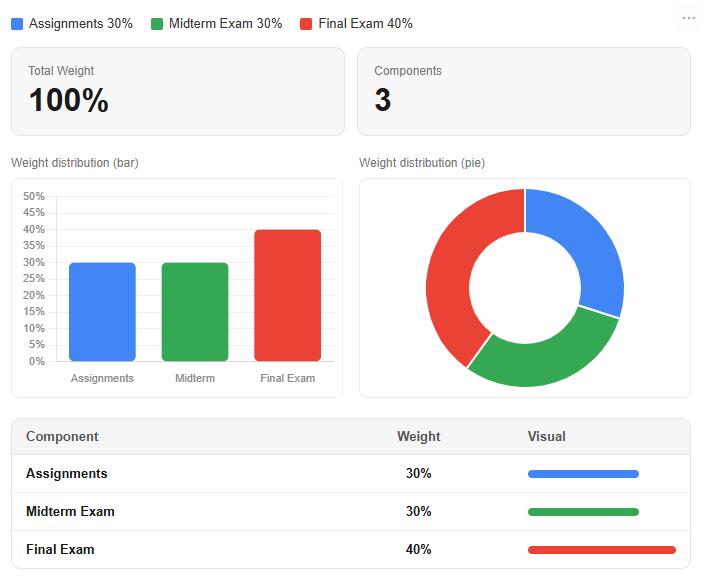
The calculator uses these percentages to estimate the final result. Students only need to enter their current grade and the weight of the remaining exam.
This makes it easier to understand how much effort is required to reach a desired grade.
Why Students Use a Final Grade Calculator
Students use this tool for several practical reasons.
Track academic progress
A calculator helps students understand their current standing in a course. It shows whether the current performance is enough to reach the target grade.
Plan study time
When students know the score required on the final exam, they can plan their preparation more effectively.
Reduce uncertainty
Waiting for the final result can create stress. Estimating the grade in advance gives students a clearer picture of their situation.
Set realistic goals
A calculator shows whether a target grade is achievable based on the current scores.
How a Final Grade Is Calculated
Most schools use a weighted grading system. Each activity contributes a specific percentage to the final result.
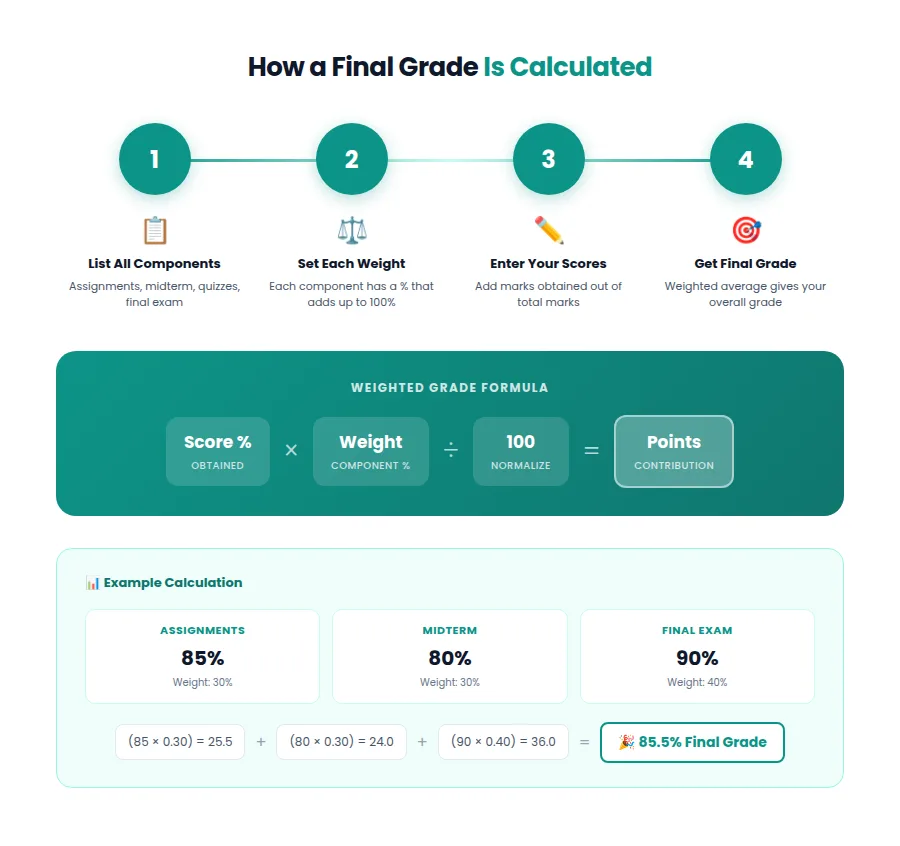
The calculation follows a simple idea:
- Determine the current grade based on completed work.
- Multiply each component by its weight.
- Add the weighted scores together.
For example, consider the following situation:
- Assignments average: 85% (30% weight)
- Midterm score: 80% (30% weight)
- Final exam: 40% weight
First, calculate the weighted contribution:
Assignments
85 × 0.30 = 25.5
Midterm
80 × 0.30 = 24
Current contribution
25.5 + 24 = 49.5
The final exam will determine the remaining 40%.
If a student scores 90 on the final exam:
90 × 0.40 = 36
Final grade
49.5 + 36 = 85.5
The overall course grade would be about 86%.
Steps to Use a Final Grade Calculator
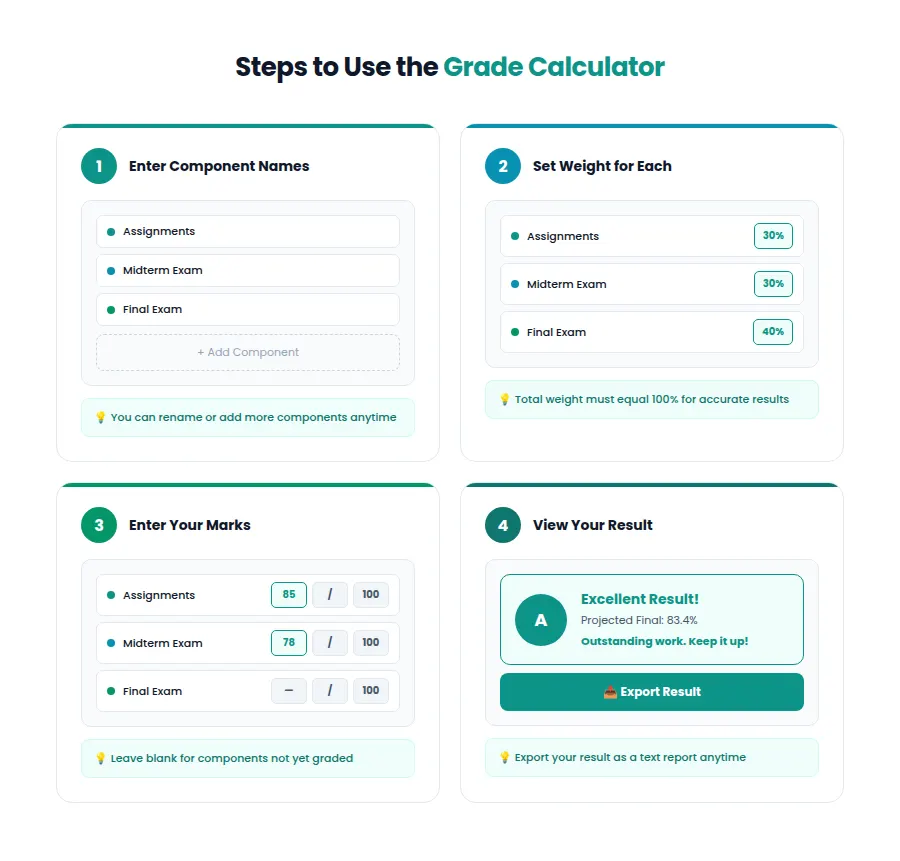
Using a final grade calculator is simple. Most tools require only a few inputs.
Step 1: Enter your current grade
This is the average of completed assignments, quizzes, and exams.
Step 2: Enter the weight of the final exam
Many courses assign 30% to 50% of the final grade to the final exam.
Step 3: Enter the desired final grade
Some calculators allow students to set a target grade.
Step 4: Calculate the result
The tool will show either:
- the expected final grade, or
- the score needed on the final exam.
Example Scenario
Suppose a student has a current grade of 82%. The final exam is worth 40% of the course grade. The student wants to finish the course with at least 85%.
The calculator will determine the required exam score.
The result might show that the student needs around 90% on the final exam to reach the target grade.
This information helps students understand the effort needed before the exam.
Understanding Grade Weights
Grade weights represent how much each task contributes to the final result. These weights vary between courses and schools.
Common grading structures include:
Example 1
- Assignments: 25%
- Quizzes: 15%
- Midterm: 30%
- Final exam: 30%
Example 2
- Homework: 20%
- Projects: 30%
- Midterm: 20%
- Final exam: 30%
Students should always check the course syllabus to understand the grading structure used by their instructor.
What Grade Do You Need on the Final Exam
Many students use a final grade calculator to answer a common question: what score is required on the final exam?
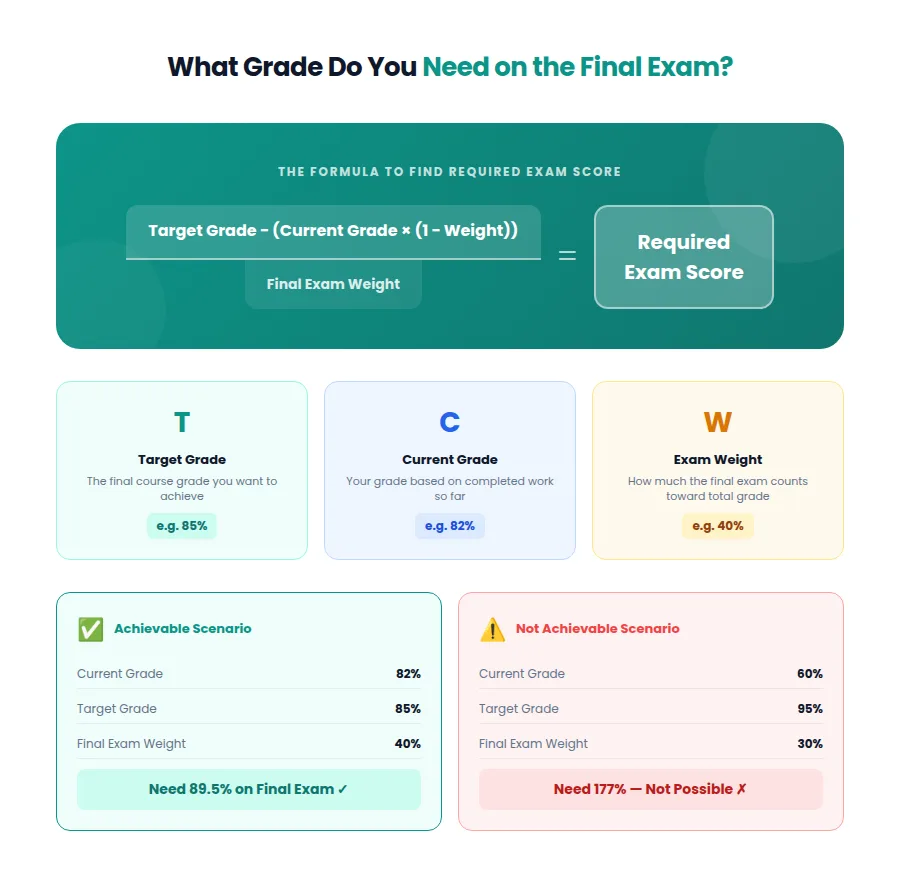
To determine this, the calculator considers three values:
- current grade
- final exam weight
- desired final grade
The tool then calculates the minimum exam score required to reach that target.
If the required score is higher than 100%, it means the target grade is no longer possible.
Benefits of Using an Online Final Grade Calculator
Online calculators save time and reduce calculation errors. Students do not need to work through complex formulas.
Key benefits include:
Fast results
The calculator provides results instantly after entering the required values.
Accurate calculations
Automated calculations reduce the chance of mistakes.
Easy to use
Most tools only require basic inputs.
Helpful planning tool
Students can estimate different scenarios and see how each one affects the final result.
Tips to Improve Your Final Grade
If the calculator shows that a higher exam score is needed, students can take steps to improve their performance.
Review course materials
Go through lecture notes, textbooks, and previous assignments.
Practice past exam questions
Past papers often show the format and difficulty level of the exam.
Focus on weak areas
Identify topics where your understanding is limited and spend more time reviewing them.
Create a study schedule
Divide study sessions into smaller periods over several days.
Ask for help
Teachers and classmates can help clarify difficult topics.
Common Mistakes When Calculating Final Grades
Some students make errors when estimating their final grade. These mistakes can lead to incorrect expectations.
Ignoring grade weights
Every component has a different weight. Treating all scores equally can produce wrong results.
Using incorrect averages
Students sometimes use the overall percentage instead of the weighted average.
Forgetting extra assignments
Some courses include projects or participation grades that affect the final result.
Using a calculator avoids these errors because the formula is already built into the tool.
When to Use a Final Grade Calculator
Students can use this tool at different points during the semester.
- After midterm exams
- Before the final exam
- When planning study goals
- When checking if a target grade is possible
Using the calculator early in the semester can also help students adjust their study habits.